. 


. 


Added thought from Stacy, who took notes Thursday and would like to add the following email she received from Liz on Oct. 6, regarding this quote: “Dr. Jane chose, every single day, to make the world better. I hope, in her honor, we all choose the same.” Now, back to last week’s meeting:
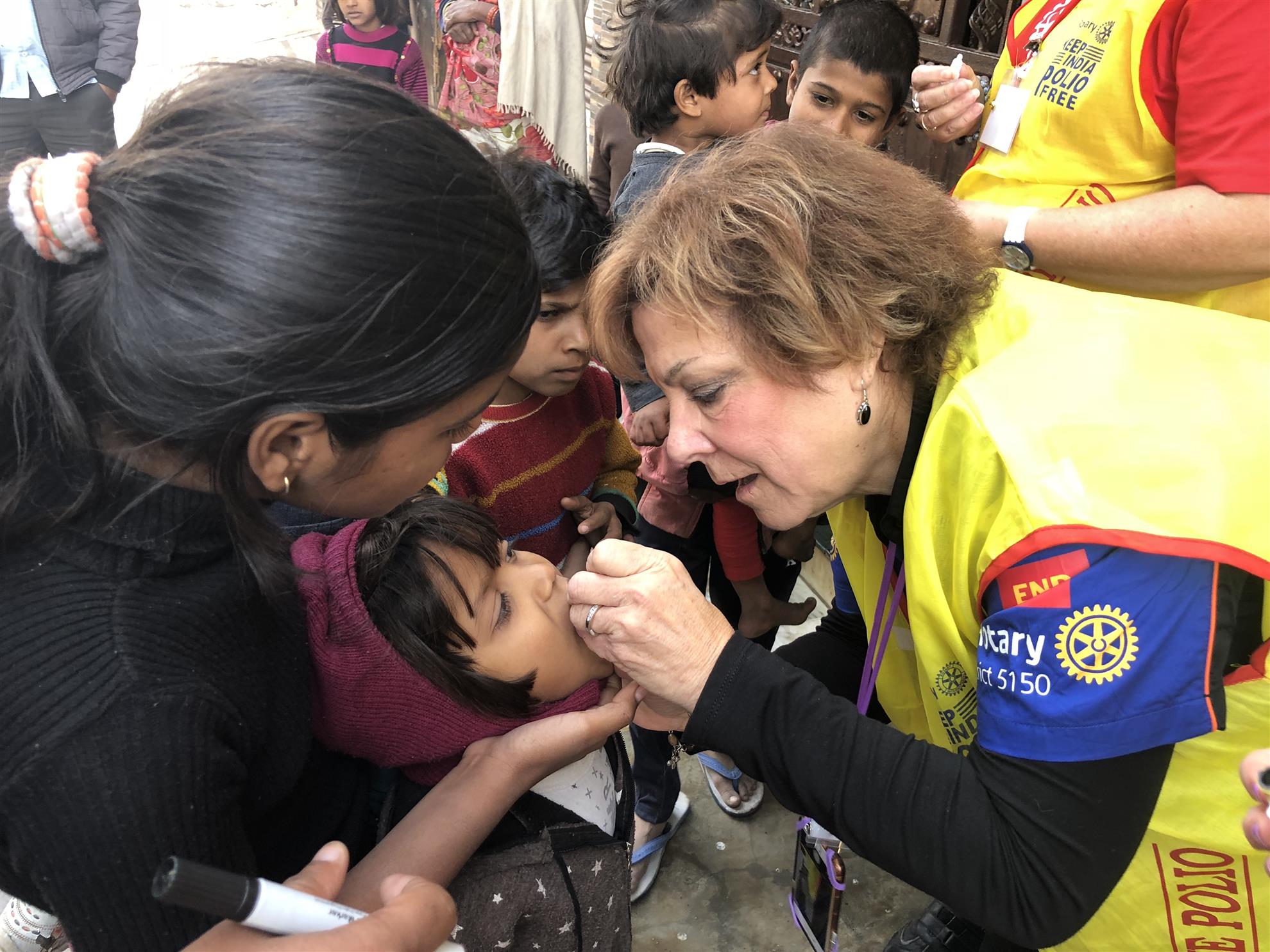
Kevin noted, “at the risk of offending some of our guests today,” he welcomed all “to the best Rotary Club in the world” which brough cheers. He also added “I’m sure also, like you, your members all arrive on time,” and ready to start the meeting,” and when latecomers arrive, we’ll be sure to welcome them.” Visiting Rotarians included the speaker; guests for the meeting including Larkin Evans, still a guest until she fills out her application, Kevin said. He went on to note that next week’s meeting will be a social at 5 p.m. on Thursday, so we’re not going to have a meeting, at noon at the library. He asked for suggestions for where to have it; Sue has offered to hold the Christmas party at her house; location suggestions included from Stacy, though we just had a social at her house so it might be a bit soon; so her home is available if needed. Kevin thought we might do it at a local restaurant or bar, or whatever … Ralph also noted that since Kevin had a new remodel at his home, (“We’re close” his wife Debbie said, according to Kevin.) The Polio Plus jar went around. We’re this close, Kevin said, holding up two fingers very close together and noting that now polio was now in two countries, Afghanistan and Pakistan. And Oct. 24 is World Polio Day. He’s not sure how we will recognize that day, but “we will do something.” He noted that the small donations jar is also going around.
He said there’s already a donation in there because our new member would like to share some information about her business.
The new member, Karen Senffner, said she was looking for a long time and is happy now to have found a place to practice in – Shoreline Station. To tell about her business: She is a physical therapist, has been one for 34 years, and the particular technique she does is called “zero balancing.” It is centered at the level of bone, and helps relieve the stresses that all of us hold, following something recent like an accident, a fall, surgery, or something carried with us for a long time. She noted that this is not traditional physical therapy; Kevin noted that he and friends have found physical therapy very hard to get following procedures such as like joint replacements, “you have to wait a long time.” She thanked us for taking time to listen to her.
John Evans was asked for an update on our exchange students. He mentioned Suzanne’s tennis buddy Emma Todd, (Suzanne was an exchange student here two years ago), and exchange students Pascal (exchange student from Italy) and Vicki (an exchange student with a San Mateo Rotary Club) were invited to go with Emma’s family to Gilroy to go apple-picking in orchards there (he was happily eating an apple right then from one of those orchards.) He said that besides apples there were pears, avocados and peaches. What was really interesting, he said, was to see the three teenagers having a great time. Vicki and Pascal had met, but had not met Emma, and John said it was like they all were kindred spirits, laughing and singing in the back seat and unaware of the adults in the front seat paying attention to them. He added that recently they had gotten an unexpected face-time call from Caroline from Belgium, an exchange student 10 years ago that many of us remembered. She is now 27 and she was talking about how different her life is now than when she was a teenager. She is now, this week, in her second year of residency; last year she was in an ER residency and this year an OB-GYN residency. For six years. This is all in Brussels. She said, be sure and say hi.
Kevin said, such a wealth to have these relationships with these young people. Just to add to that, another club member added, many years ago, their girls went over to Taiwan for high school, played basketball, and next year the Taiwanese kids came over and played basketball here. But when they arrived, we were all set up to play basketball, but they weren’t basketball kids, they were dancers. Which created a little problem but not much; they went and they danced at all these things. These girls did not speak much English, and our girls didn’t speak any Taiwanese, but they stayed with us for about three days … and they got in the hot tub and they were just chattering away, and we had no idea how they were communicating but they were.
Kevin asked for any other announcements?
Liz said the had one from Drew from the school district for those of us that signed up for Principal for a Day next Tuesday from 9 to 11: He will be sending us confirmations of our assignments; there was some playful bantering between Barb and Kevin about schools; Barb has Cunha and Kevin will go to Farallone View. Barb has a lot of relationships; she successfully pleaded her case, Kevin said.
Kevin said that we have an exciting meeting today, for two reasons: one, we get to learn more about one of our new members, and two, we get to learn about a project that is “really innovative and exciting and will inspire us, hopefully, to do something that we would love to do here, locally.” We might even work with them, who knows.
SUE PRITCHARD - SHOP TALK
First of all, I’d like to ask Sue Pritchard to come up and do your shop talk. We call them “shop talks” because back in the day, you guys – especially the ones who have been around forever, who started the club – remember how it used to be about exchanging business leads and that kind of stuff? We called it a shop talk because it was about your business. We’ve always called it that, even though, really, what it has evolved to is just tell us about yourself, your family, that sort of thing. So, give Sue Pritchard a warm welcome! (applause)
Sue said: I graduated from U.C.L.A. with honors, (“Go Bruins!” Liz yelled,) and then my father died very, very suddenly. He was a founder of Long Beach Memorial Hospital, and my family just fell apart. Then I married somebody who ended up in law school in San Francisco, so there I was; and he become a hippie. So somehow, I survived all of that, which is delightful. I thought – the butterfly goes through an egg, and then a chrysalis, and they finally turn into a compound chrysalis and then an adult butterfly, and then the whole thing starts all over again. It’s a life cycle, and I’ve been through a lot of those. I’ve slept in a barn, I’ve slept in my car, I’ve been on food stamps, I‘ve been to Paris (couldn’t make the name of the location out) first class, and … I’ve painted in Monet’s garden twenty times, when only eight people were there, and it was a delight, an honor. I don’t know how I got there; it wasn’t just about money, it’s just that sometimes the universe puts you where you are supposed to be. I wanted to go to art school when I was a kid, (and) my father said oh no, no, no, you go to UCLA, become a teacher, and then you can support yourself the rest of your life, you won’t need to depend on anyone. And he was so right (laughter) … I was one of seven people that graduated from art school, and they were doing crayons – white crayons -- on white paper, and then maybe watercolor over that, so you could see the resist. It was like kindergarten. And I was like, what’s going on here folks? … and they’ve done it all, it’s like boring, and then they started all over again, and I’m glad I didn’t go through that cycle. I learned how to paint on my own, I learned how to mosaic on my own, and I did that huge mosaic on the Goldworks building, Joe Cotchett hired me to do that, because I won a grant, and we were mosaicking Mac Dutra Park.


Visiting and guests of Rotarians: Rosario from the San Carlos club, who, Liz said, wanted to come see how we ran our meetings. Guests of Rotarians: Susan Kealey introduced her partner Dennis Fisher, and Stacy Trevenon introduced her husband Doug Mallon. Guest Gail Evenari is on her way. There was some brief discussion as to the beginning time of the meetings: Dianne Bobko noted that on our Web site page the starting time of our Thursday meetings is noon. Kevin started the Polio Plus and small donations jars around, and emphasized what we are raising money for: to respond to requests from the community.
Ginger was introduced; she said she missed everyone when she was away over the last couple of months; in the tradition of the Rotary club Foundation, she presented a check for her birthday: when asked, she said it was for $74. (Applause!)
No more news, so Kevin started to introduce the speaker, but it had to hold for a moment; Irwin Cohen spoke about radio station KCSM and its diverse jazz program he’d long been a fan of (“a big spectrum of music,”) Latin, salsa, jazz and more -- which he feels he can’t live without. Focus shifted to the station manager Dr. Robert Franklin, who has a three-page biography of which Nancy summarized the highlights: Dr. Franklin is a broadcast educator and award-winning producer and ground-breaking journalist. He is the former general manager of WCSU-FM, San Diego State University. He has spread compelling programming including a focus on polio and interviews and documentaries “designed to enlighten, educate and inform the community.” His many awards and recognitions include the Congressional Journalism Fellowship that involved a one-year stint in the halls of Congress. He put that experience into a national radio documentary that featured women in Congress. For more than 26 years he has strived to make the world a better place. He is a PhD graduate of Arkansas State University, and a master of arts and bachelor of science graduate of Jackson State University. His journey has, she said, allowed him to educate, empower and give back to the community and impact the world. Great applause followed his remarks.
Magic of the Coasatside Libster Fest 2025 - Fund-A -Need Checks Presentation
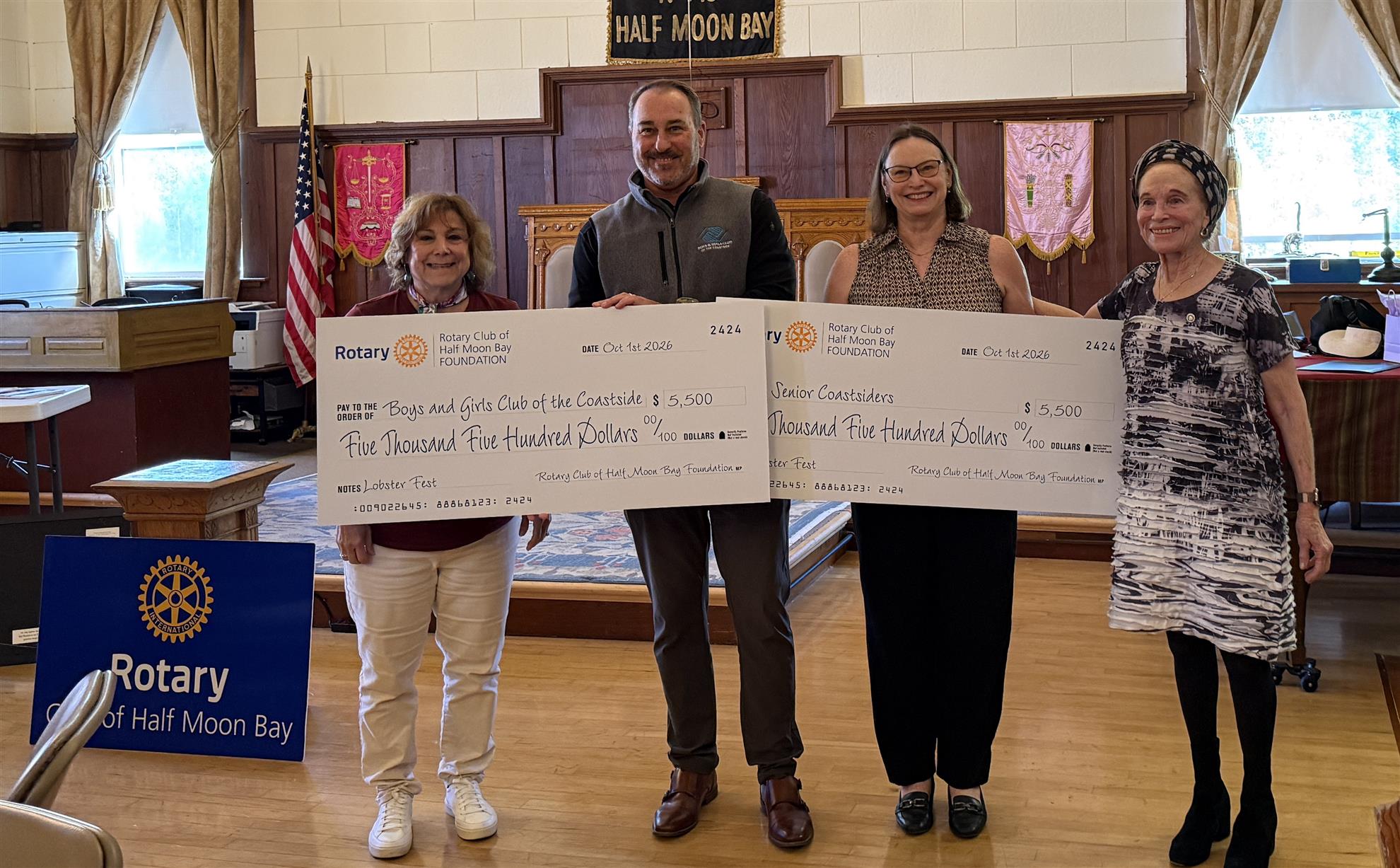
Kevin noted that since a couple of people in the audience had to leave early, so he asked us to remember what was said and switched to important business: He invited the Lobsterfest committee to step forward to acknowledge them, and mentioned the funds raised at Lobsterfest this year. He recalled that initially several local nonprofits were asked to submit grant requests, and from those, the Big Wave Project and the film “Maiden Voyage” were chosen. The goal was to get $4,000 grant to fund the Big Wave celebration and the film; and any funds raised in addition to that would go to the club foundation for other uses. It turned out that the Lobsterfest “did significantly better” than the Rotarians thought it would; we had some “extremely generous people there that night,” and so the club presented these amounts to Jeff Peck from the Big Wave Project and Gail Evenari from the film.
Invited to tell about Big Wave, Jeff noted that it is a project that took some 25 years to start, and is a community for adults with special needs. There are residential units there, and common areas, a farm (which he just left and has to go right back because this was Hops Picking Day). Gail spoke about Maiden Voyage: it is a nonprofit film production company which is making a film about learning differences and the implications of the things that happen to people who are marginalized with learning differences. So, they have a mental health journaling app that they are introducing to the Boys and Girls Club, which helps kids address and become familiar with, and get tools to help with, mental health issues.
Liz called for a drum roll, and made an announcement: we are dividing three ways: giving each organization not $4,000, not $5,000 … but $9,536 (great applause!) Jeff pointed out how much it means for the community to come together and donate to help these projects. He added that there will be a site visit to the building (which will be done in March), and we are invited to see where the money is going; the visit will be on Oct. 12. He hopes to see us there; he’ll be there with Julie Shenkman (he was the founder of Big Wave but thinks that Julie will “speak and look much better than I do.”) (applause)
Gail spoke about the whole process, crediting the Rotary club with its generosity, and acknowledging that the money will be put to to use (“I can use every penny,”) and she said she would introduce this not just to the Boys and Girls Club but to the middle school and high school as well (“and, Kevin said, come back and show the film as well”.)
Gail mentioned the Big Wave festival on the past Saturday, and how much the residents and club members and their families who were there, enjoyed this “amazing” event.
“We’re very proud to be partners,” said Kevin.
Kevin mentioned that perhaps Nancy did not know this, but Dr. Franklin was a Rotarian. “He can be again!” shouted Liz.
“And he’s tall,” added Kevin, before introducing Dr. Robert Franklin.
Presenetation by Dr. Robert Franklin of KCSM
Dr. Franklin began by recalling how the Rotarians from Arkansas (where he was in a club) helped him understand the power of giving to the community. One thing that he’d done that he was proud of was participating in the Big Brothers mentoring work, helping kids go to school and meeting and being mentors for them. The other thing he liked about Rotary was its several community initiatives, one of which dealt with literacy; another looked at reducing obesity in Arkansas.
He said he was happy to be here” with fellow Rotarians; he felt “always a Rotarian.” He had a slide presentation about him and his journey, from Arkansas to Texas and now California. He said this (KCSM) was his 13th station; 13 is supposed to be an unlucky number, but “the luckiest for me” in terms of what it’s meant to him, and in terms of the inspiration he’d found here that he hadn’t experienced as a manager. He spoke of what drew him to this station – he’d worked at classical, contemporary, blues and jazz stations -- but what drew him to KCSM was when he looked at the station’s Web page and saw that they did community events, as what he called “jazz curators,” or the most influential deejays he had worked with – their knowledge base, passion for what they are doing.
Coupling his presentation with slides, he clarified that this was not just a public trust but a public sacred trust, meaning that the relationship that public radio has with its listeners is a personal one – you feel you hold ownership of what’s going on at the station. You become one with the curator – or the deejay – he or she becomes part of your family; you feel like you know them since they have been there a long time in terms of music. What they have given you – in terms of music and in terms of escapism from what’s going on in the world – is like a secret place you can go. You can be sure you’re being taken to a place of peace and tranquility, where you and your better selves can exist – what you get when you come to KCSM.. Public trust – “and we take that very seriously.” And everyone who has been at the station, even for a long time, has that “sacred commitment.”
They have autonomy, and inside the studio, they create – curate what you hear, and it is powerful, and it moves you; as a public service or trust and they want to strengthen, not abridge, that trust, even more so now. We don’t do advertising, we do underwriting. Our sponsorship is pretty basic.
Sen. Hill began by thanking Rotary for having him here, noting that Half Moon Bay is one of his favorite places in San Mateo County and the world. He congratulated Pascal on being here and thanked the club for its participation today. “I learned a lot,” he said, adding that he will be in Rome in a week and a half.
The topic he had prepared was a “behind-the-scenes tour” of what they didn’t teach in high school civics class. Starting in the California state legislature years ago, he found he had led a sheltered political life in San Mateo County because everyone gets along and works together to solve problems. Egos are not a problem; you find them in San Francisco to the north or San Jose to the south. When he arrived in Sacramento, he found an unusual environment: special services that pampered him, and everyone laughed at his jokes (“And I know I’m not that funny!”). He found it a very seductive, environment: when you are away from home and family, it’s easy to forget who you are and what defines you. For many, it was the highest salary and best job they don’t want to lose, and they’d do almost anything to keep that position.
He said, remember our former state senator, Leland Yee, who spent six years in federal prison because he didn’t want to lose that job? He got into trouble due to his fundraising activities.
Once settled in Sacramento, Hill found distinct areas of power and influence that shaped what happened in Sacramento and became California law: relationships you build and how you use them, your home district, where you come from -- (he represents a million people from basically South San Francisco and Los Altos and Sunnyvale to the south), policy (the issues that you want to bring to the legislature, issues that you think are important, that you want to make change, and try to influence the policy and the future of California) and how money and politics shape the future and what happens in Sacramento.
He said relationships are so important in Sacramento. There are 80 members of the Assembly, so the magic number is 41, if you want to get anything done. In the Senate there are 40, so you have to count to 21. And the same with the Half Moon Bay City Council: there are five members, “so you gotta count to three; if you can’t count to three, nothing happens.” So he made it a policy: every year, when new members of the legislature were elected and came to Sacramento and came to the Capitol, he made it his policy to go spend some time with them, regardless of party, sit down with them, learn what interests they had, why they were there, what they wanted to accomplish, and what was important to them. And it really helped him: “One, I got a better understanding of the state of California, all the interests that were there, but also, what was behind them. What motivated them. And I would do that.”
He continued: “Because some, if you were in the other party, would just make enemies out of you. You would treat them like garbage, and not treat them fairly or with respect.” There was one Assemblymember from the San Diego area when he was the chair of the Environmental Quality Committee in the Senate; she had a bill that came before his committee. The funds that were collected from basically the use of fossil fuels in California to use some of those funds for traffic signal synchronization. So the bill goes to the committee staff, the staff evaluates it, and they were going to sit down with the chair and give their suggestions. They came to him and said, “You know, it can already be done, it’s not specifically called out in the law that you can do that, and she’s a Republican, so who cares if she gets her bill or not. And I said, you know, I like traffic signal synchronization, I think it’s a good thing, and I think it’s a good idea to call it out, specifically to incite that, incentivize it. And I don’t care if she’s a Republican or not, it’s a good idea! So … I got her bill out of the committee, I said, we’re going to move the bill forward, and vote it out, and she asked me, this is the Assembly member, Marie Walgren is her name, she asked me if I would floor manage the bill for her, on the Senate floor, because that’s how you do it. Assemblymembers ask Senators to carry their bill on the floor, stand up and present it to the body, and then they vote on it. The same the other way around. I have to ask people in the assembly. So I (said) sure, I’d be happy to. So I presented the bill, it passed, the governor signed it, it became law, and it is today.
“A few years later —two years later – I had a bill in the Assembly. Passed the Senate … on the Floor. So I go in – you can go onto the Floor, in the House, lobby the bill, twist arms, break arms, whatever you do to get the vote – The number was actually 40. I needed 41. Didn’t happen. Couldn’t get help from Democrats, so I went to Marie, I said Marie, I need a favor. Can you help me out on this? She looked at the bill, ‘Sure.’ Got the vote, passed the bill, governor signed it, and it became law. That’s where relationships are so important and that’s where, people have lost that focus today, and it’s very unfortunate. As I said, Some members just go and make enemies out of the other side, and they just never can make it move forward.
“The other issue is, besides relationships, the home district. The home district that you represent. As former Speaker of the House of Representatives Tip O’Neill said, All politics is local. And he’s so right. Every legislator has a good feel for their district, and what works and what doesn’t work in that district. And if you didn’t have a good understanding you weren’t going to last long in that district, You have to understand the district, its challenges, and its problems, and then you represent – I was very passionate about this district that I represented, and I was very protective of it. And to give you an example of it, and why that was important to me, is -- I read in the paper one morning, where Mark Zuckerberg, Facebook -- and I had been to Facebook, two or three times, when they were in Palo Alto, then when they moved to new offices in Menlo Park, (I) had tours, and kind of supported them, and what they were doing. Cheryl Sandberg, who was the CEO or CFO, she would call every once in a while, lobbying me for bills that she wanted, and trying to get support on some issue. And I read a comment that he had said, ‘We’re not going to expand any more in San Mateo County. We’re going to move and do our expansion elsewhere.’ He said, ‘The traffic’s too difficult here, it’s too hard, housing price are too high, and it’s just not fun anymore. We’re not going to stay.’ I said to myself, You son-of-a-gun.
“So about a week later, I’m speaking to the Palo Alto Rotary Club, and I look in the audience, and there is the editor and publisher of the San Mateo Daily Post, the newspaper. And I looked at him and I said – I thought to myself, do I want this in print or do I not? – (laughter, especially from me) and then I said, Yeah, I do. So if I said, You know, I read this in the paper last week, here’s what Mark Zuckerberg said, I said, you know what? I said, he’s no different than a strip miner. Comes into town, causes the problem, changes the housing prices, causes the congestion, and then he wants to move out, after he has already taken advantage of us.
“Well, it didn’t take long, a couple of days and that was in the paper, and a quote from me. Well, about three days later, I hear that Cheryl Sandberg is out trying to find someone to run against me in the next election. So that’s how powerful they are, but to me, it’s important that you know and understand the district that you represent. All politics is local.
“The third area of importance is policy. The policy that we all have. You may wonder why there are so many laws in California? That’s because, there are so many bills. And the reason for that is because each legislator tends to write 35 bills, every two years. He or she can write 35 laws, and then it has to get through the legislature. That’s four thousand, two hundred new laws that we can see every two years. (‘Wow,’ someone murmured.)
“It starts with an idea… so that is 4,200 bills. If you have thirty-five bill opportunities, you’re gonna use every one of them. You have to show your constituents that you’re doing something.… And sometimes when the deadline comes, legislators are scrounging, looking for things to put in those bills so that they can look like they’re doing something in the legislature.
“Former governor Jerry Brown once correctly said, Every problem doesn’t need a new law. Of course, every one of the problems I was trying to solve we needed a new law (laughter.)
“So when you get to the legislature, usually people come for a couple of different reasons. You want to come and solve the transportation problem, you want to solve the climate change problem, you want to solve the education problem. Those are some of the areas people focus on then they come to the legislature. When I went to the legislature, for some reason, problems seem to find me. When I kept looking for problems, I didn’t focus on one area of importance, I focused on trying to make our lives better. That was the goal that I had; trying to find problems that needed solutions. That was the real movement that I had.
“It starts with an idea: sometimes constituents bring in an idea, sometimes you see it … For me, it just kept falling in front of me. The San Bruno gas explosion, that fell in front of me, when they killed eight of our constituents in our neighborhood, and destroyed 28 homes. And we found that $500 million of money that was supposed to go for maintenance and repairs, PG&E diverted to profits and bonuses for their executives and their employees.
“Today, they stole our efforts, there’s a Golden State Energy Act that we’ve had. I worked closely with the governor, and now if PG&E does that again, the state doesn’t have to use eminent domain, they don’t have to do anything, they can go and take PG&E, and turn it into a nonprofit state corporation that will then operate with us. So that’s what we can do if they do that again.
“One of the things that also made me mad, I found a 16-year-old student from Los Altos, called me and said, You know there’s a 13-year-old in our school who’s engaged to get married to a 28-year-old from another country. (I said,) that can’t be true. It is true! In California there’s no minimum age for marriage. All you had to do at the time was get a judge to check a box. One parent goes before a judge and checks a box; that’s all you had to do. So we changed that now; there’s still no age requirement, I wanted an 18-year-old age but we didn’t get that far, (but) we made it a heck of a lot tougher for anyone to get married.
“And one of the other things that I got mad about: a 19-year-old lives in Burlingame went to a 21-year-old’s birthday party and they went on a party bus. He drove his car to a parking lot, got out of the car, went into a bus, they had a dancing pole, music, alcohol, they were drinking to the 21-year-old. No one stopped him from drinking, he drank, came back, got out of the bus, got in his car, and as he was driving down 101 at Poplar, he ran into the sound wall and killed himself.
“So, something’s wrong. We found that there were no restrictions, no requirement, the bus company said, our responsibility is just driving the bus, what happened behind is none of our concern. Well, it is today. Because now, if you want to have drinking on a bus, any bus, and there are minors on board, there has to be a 26-year-old on board that will take legal, and civil, responsibility for what happens afterwards. And no one’s going to do that with anyone underage.
“So the last one of what I wanted to give you an example of, how I got mad, in California we have enterprise zones. An enterprise zone is, you go into an area of economic disadvantage, and you can form an enterprise zone, and for every business within that zone the employer can get a $28,000 tax credit for every employee. We found that San Francisco’s financial district is an enterprise zone, at the time, and the law firms in there were getting nothing. We also found that in Rancho Cordova there was a strip club, and the strip club was getting an enterprise zone tax credit.
“So a Republican colleague of mine, we co-authored a bill, and we decided to have a press conference. On a Monday morning I drove to Sacramento, we went to the strip club in Rancho Cordova. Got out, TV cameras were there, he and I were walking up, right up to the strip club. My wife – right before I left – she said, you better hope nobody walks out of the door of that strip club and says ‘Jerry, good to see you again!’ Fortunately, it didn’t happen. We had the press conference that changed the law.


We are at 34 members, Kevin wants to grow it to 45. Kevin encourages us to invite people to our meetings.
This is Brian’s second year as Membership Chair. He’s been a Rotarian since 1998 and is uniquely qualified for this role. His first club was very old school club in Vacaville. He moved to SF and joined the much smaller/newer Bayview Club. He and a friend later started SFSOMA club in 2014. This club now meets monthly, has 40 members and has a 50l.c.3. Every club is different. The Membership Summit last year developed a 3 year structured program. Membership is growing in rest of world and falling here especially since COVID. Retention is a huge part of membership. We need a membership culture. The service projects we work on are key to retention. We need a membership culture. The five things we should know and believe about Rotary are: membership matters, service is our product, attrition is real, retention is a long term goal and
Why join Rotary? The satisfaction of giving back, the camaraderie, personal growth, international projects…there are many reasons.
What makes up the club experience. Enjoy meetings, confidence in leadership, comfortable and meaningful relationships. Why do members leave? The culture isn’t a good fit, unmet expectations, time, financial and personal reasons. It is important to reach out to members who haven’t shown up, many quit within a short time.
Clubs need to have a membership plan—set goals, have a long term plan and every club member is responsible for the success. He suggested taking the pulse of your club—try Brainstorming, GAP analysis, targeted recruitment. Set a meeting aside specifically to work on this. Some clubs only meet once a month, since we meet more often, perhaps this would work. The key is finding a time that works for people and make it intentional. He suggested we emphasize the international aspect of Rotary. Be innovative, search outside the box.
Once you have a plan, you look for prospects—perhaps target certain community members, etc. Keep track of prospective members, invite them to meetings or projects. When it comes to onboarding, make sure to have membership packages, maybe mentors. Make it feel special, have a ceremony and invite family. Some ideas: Leave a Rotarian magazine at the library. We could get one in Spanish. We could do a global grant to work with a club in Mexico to attract Hispanic members. Rotary has a stuffy image, try to break through that image.
Think about retention. Retain existing members with meaningful involvement, opportunities for them to contribute to projects that interest them. Create a welcoming inclusive environment and organize social events to foster camaraderie. Seek feedback and address concerns, keep communication open and effective. Encourage mentorship and leadership.
Be a vibrant club. Good leadership, multi-year planning, shared vision, commitment to adaptability, has a relationship with the community and be welcoming and fun.

Heather provided us with a stirring quote that reminded us all of the importance of teachers.
Introductions began with our library staff and Liz moved on to introduce our new Superintendent, Ramon Miramontes. Administrative staff were introduced and Administrative Assistant Jackie Sullivan was congratulated on her upcoming retirement after 29 years of service.
The principals were asked to introduce themselves and their new staff members. We heard from 22 teachers, counselors and psychologists. Afterwards we Rotarians introduced ourselves.
John Evans introduced our exchange student, Pasquale who is here from Sardinia.
As always, the sense of excitement was palpable. I’m sure these amazing individuals will make a difference in their students’ lives.